
ECO-BOX WALL
ECO-FARM
Flooring and wall coverings for stables and equestrian facilities.
Wall protection for stables
Rubber wall lining for horse boxes and stables
ECO-BOX WALL is a rubber wall covering for stalls and stables. It is applied to the lower portion of the wall, where the horse is most likely to come into contact with wood, masonry, or concrete. The sheet covers a 1.25-meter-high section and extends along the wall for 8 meters or 6 meters, depending on its thickness. It can be cut on-site to fit around corners, posts, and openings.

Wall Protection
The rubber creates a resilient layer between the horse and the rigid support and helps protect the wall from contact during daily use.
Two thicknesses
The sheet is the same height in both versions. The roll length is 8 m for the 8-mm-thick sheet and 6 m for the 10-mm-thick sheet.
Mechanical fastening
The panels are primarily secured using screws or rivets suitable for the substrate. A perimeter frame can cover the edges and help support the panels.
01 / Product
A protective strip for the lower part of walls
In stalls and stable corridors, the lower portion of the wall is often the part most exposed to contact with the horse. ECO-BOX WALL covers this area with recycled rubber from end-of-life tyres. The elastic surface reduces direct contact with wood, concrete, or masonry and helps preserve the substrate during daily use.
The roll format covers longer sections of wall with fewer joints. Once measured, the lining can be cut on site to fit the shape of the horse box and sit flush around doors, uprights and corners. Finishing the edges and choosing the fasteners are part of installation.
02 / Installation video
How to install the ECO-BOX WALL lining
03 / Applications and gallery
Where to Use ECO-BOX WALL
The padding is used where horses walk or stand near hard surfaces. In stalls, it follows the inner perimeter; in hallways, it covers the most exposed sections of the walls; and in vehicles, it conforms to the shape of the interior walls.

Horse Stall Walls The lining follows the shape of the interior walls and can be shaped to fit around the posts and openings of the stall.

Stable Corridor In these areas, the sections most exposed to contact with the horses are covered, even on continuous surfaces.
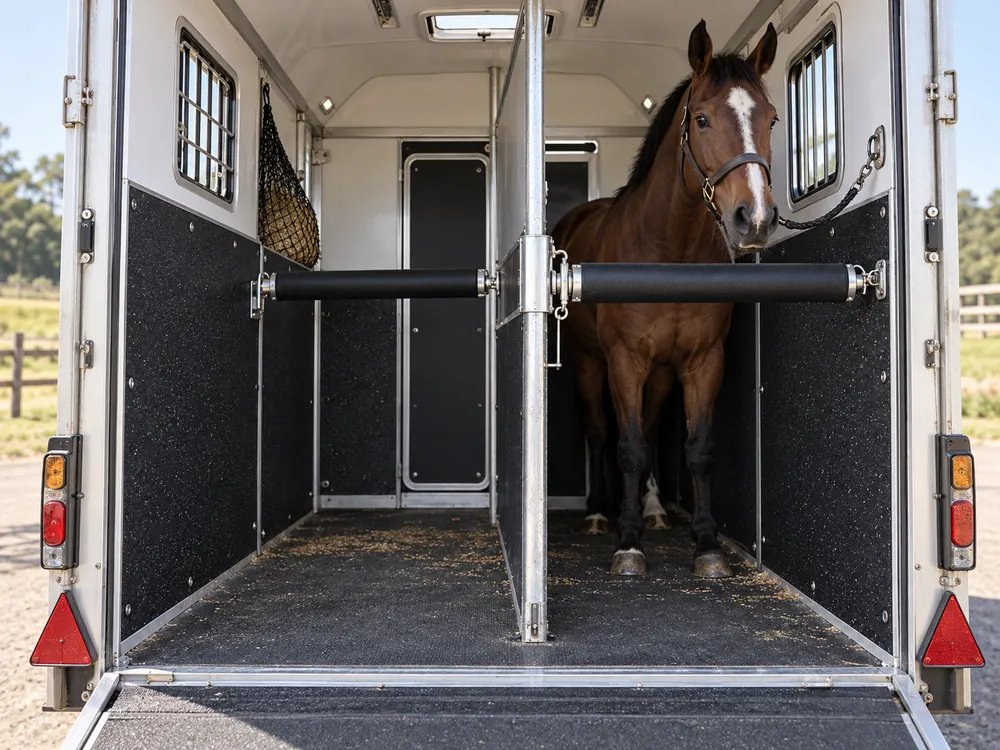
Horse Trailer Walls The liner fits the interior walls of the trailer. The fastening method should be chosen based on the mounting surface and the dividers.
04 / Product Information
Installed height, length, and thickness
When unrolled along the wall, the sheet covers a 1.25-meter-high strip before being cut. The roll length is measured horizontally along the wall. The thickness refers to that of the rubber. To estimate the amount of material needed, measure the total length of the walls to be covered and account for cuts around corners, doors, and uprights.
| Rubber thickness | Height on the wall | Roll length |
|---|---|---|
| 8 mm | 1.25 m | 8 m |
| 10 mm | 1.25 m | 6 m |

05 / Finishes
Solid black and speckled melange
Both finishes are made from recycled SBR rubber derived from end-of-life tyres. The smooth black finish has a uniform appearance. The speckled melange finish is achieved by adding colored rubber granules (EPDM) to the mixture, which remain visible on the dark surface. The close-up photos show the difference between the two finishes.


06 / Installation
How to fix the lining to the wall
Check that the wall is stable, even, clean, and suitable for the intended fasteners. Unroll the sheet before cutting it, so that the material loses some of its curvature. Take measurements and trim the sheet on-site using appropriate tools, taking into account corners, studs, and openings.
Attaching to the Substrate and Finishing the Edges
The mounting is primarily mechanical. Use screws or rivets suitable for the wall and, if necessary, supplement the fastening with an adhesive compatible with the rubber and the substrate. Where the layout allows, a perimeter frame can be installed to cover the edges and help support the panels cut from the roll.
Align the panels so that the seams are even, and make sure they fit snugly against the wall. Ensure that the frame connects properly with the uprights and other parts of the structure. Edges, trim, and fasteners must be free of rough edges or protrusions that the horse could reach.
07 / Cleaning
Cleaning and inspecting the wall lining
For routine cleaning, remove surface dirt and wash with water and a mild detergent compatible with rubber. In areas where dirt accumulates, use a soft-bristled brush. Avoid solvents, strongly acidic or alkaline detergents, and other harsh products.
Periodically check that joints and fasteners remain intact. If you have installed a frame, also verify that the profiles are flush with the wall and that the edges remain covered.
08 / Documentation
Documents for Your Project
You can request the ECO-BOX WALL documentation by contacting Casei Eco-System.
REACH Declaration
Available upon request for material verification.
Technical Data Sheet: Available upon request.
09 / FAQ
Frequently Asked Questions About ECO-BOX WALL
Answers to the most common questions, from choosing the roll to installing it in horse boxes, stables and horse trailers.
What part of the wall does ECO-BOX WALL cover?
The lining covers the lower portion of stall walls, stable aisles, and horse transport vehicles, where contact with hard surfaces is most frequent. When installed, the sheet reaches a height of 1.25 m and can be shaped on site to fit the wall, posts, and openings.
In what thicknesses is it available?
Two thicknesses are available. The 8-mm roll is 8 m long, while the 10-mm roll is 6 m long. In both cases, the height of the sheet on the wall is 1.25 m before cutting. To calculate the number of rolls needed, measure the total length of the walls and account for the necessary cuts.
How do you attach the wall covering to the wall?
The panels are primarily secured mechanically, using screws or rivets suitable for the substrate. A compatible adhesive may be used to supplement the fastening. Where the wall allows, a frame may be installed to cover the edges and help support the panels cut from the roll. Edges, frames, and fasteners must be free of protrusions accessible to the horse.
Can it be used on the walls of vans and trailers?
Yes. ECO-BOX WALL can be used to line the lower section of the interior walls of vans and trailers. The fabric is shaped on-site to fit around partitions, uprights, and openings. The choice of fasteners and any framing depends on the vehicle’s structure and the wall material.
How do you clean the covering?
For routine cleaning, use water and a mild detergent that is safe for rubber. A soft-bristled brush helps remove stubborn dirt. Avoid solvents and harsh chemicals, and take advantage of the cleaning process to check the condition of the edges, seams, and fasteners.
10 / Contact Us
Let’s talk about the walls to be covered
Describe the walls you want to cover, specifying the height, length, and material of the surface. If there are studs, openings, or edges that need to be finished, include a sketch or a few photos. We’ll help you estimate how many rolls you’ll need and which mounting method to use.