

Application / Playground Safety
Playground safety surfacing in rubber for parks and playgrounds
Modular flooring, resilient surfaces, and accessories for designing safer and more functional play areas. When selecting a solution, consider the area’s intended use, existing equipment, critical fall height (when applicable), subfloor, drainage, and installation method.
Play Areas
Parks, schools, recreational areas, and surfaces under playground equipment
EN 1177
Available on specific fall protection solutions
Subfloor and Installation
Thickness, drainage, perimeters, and fasteners must be designed together
01 / Application
Surface safety starts with the risk of falling
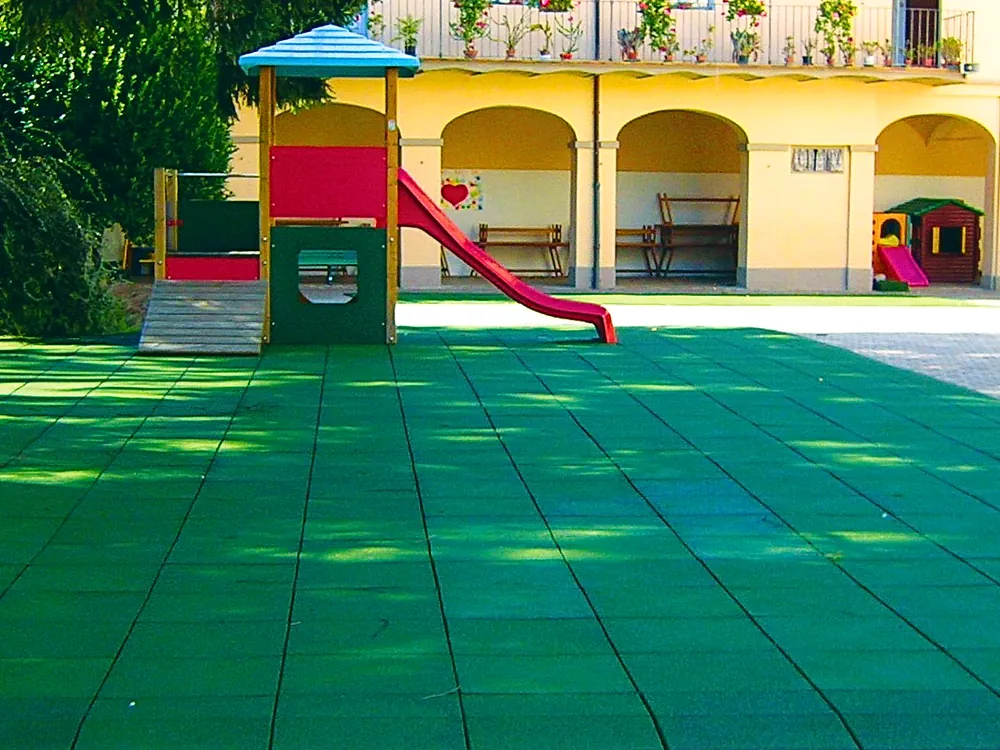
In a playground, the paving is not a separate element from the play equipment installed. Fall height, equipment placement, surface area, subgrade, and continuity of installation must all be considered as part of the same design.
The space and the equipment work together
Fall
Check the required critical height when playground equipment is present
Drainage
Water management and substrate preparation affect the functionality of the surface
Continuity
Joints, edges, ramps, and transitions properly finish the surface
Modular rubber flooring allows for the creation of continuous surfaces by joining individual tiles side by side, incorporating edges, ramps, and custom features as needed.
When the surface is installed beneath playground equipment or structures where there is a risk of falling, the choice of thickness must be based on the performance specifications of the particular flooring and the critical fall height specified in the design.
In areas without permanent equipment, however, solutions with different characteristics may be considered, always taking into account the intended use, environmental conditions, stability of the mounting surface, and maintenance procedures.
There is no single impact-resistant thickness that applies to every area: the product and configuration must be selected based on the actual conditions of use.
EQUIPMENT
Are there any playground equipment that pose a fall hazard?
The equipment and its corresponding drop height determine the choice of surface when specific protection is required.
BOTTOM
On what surface will it be installed?
Artificial surfaces, soil, grass, and other surfaces require different products and preparations.
PERIMETER
How is the flooring finished?
Edges, height differences, transitions, and accessibility must be addressed in conjunction with the surface layout.
02 / Usage Contexts
Where to Use Playground Safety Surfacing
The intended use of the area determines the requirements, size, and installation methods. Playgrounds, schools, recreational areas, and natural landscapes may require very different configurations.
In areas with playground equipment, the design must ensure that the paving is appropriate for the nature of the play and any critical fall height.
In courtyards, pathways, and recreational areas without permanent play equipment, however, surfaces that provide comfort, durability, and protection against accidental impacts may be considered, without applying the requirements specific to areas with play equipment across the board.
The intended use and technical specifications must be verified in the documentation for the specific flooring system.
PARKS
Public and private playgrounds
Modular surfaces to be designed based on the installed equipment and the overall layout of the area.
SCHOOLS
Schools, preschools, and playgrounds
Paving for areas designated for outdoor play and recreational activities.
RECREATIONAL
Play Areas and Multipurpose Spaces
Areas to be evaluated also include zones without permanent facilities, as well as high-traffic routes and spaces.
NATURAL
Dirt, grass, and uneven surfaces
Specific cellular solutions can be evaluated on natural ground, including with dedicated stabilization and anchoring systems.
03 / Solutions
Playground safety surfacing and project accessories
Explore our playground safety surfacing products. Each product page lets you review the materials, sizes, thicknesses, intended uses, specified performance characteristics, accessories, and installation instructions for each solution.
ECO-HOLMAT
Playground safety surfacing in the form of honeycomb-patterned rubber flooring for playgrounds and recreational areas; it is drainable and suitable for natural, uneven, or sloped terrain.
Discover the product
ECO-PAV
Modular, draining flooring made of recycled SBR rubber for play areas, recreational spaces, and community areas, intended for settings without certified free-fall height requirements.
Discover the product
ECO-SOFT
Modular, drainage-enabled flooring made from recycled SBR rubber for playgrounds, school play areas, and recreational spaces, with impact performance determined by tests conducted in accordance with UNI EN 1177.
Discover the product
ECO-SOFT PERSONAL
Surface customizations using colored EPDM to incorporate “Games of the Week,” “Bell,” and geometric shapes into the surfaces designated for play areas.
Discover the product
ECO-SOFT RAMP
Straight edges, open corners, and closed corners to complete the perimeter of the playground safety surfacing and adapt its edge to the project’s geometry.
Discover the product
04 / Design
How to Choose Playground Safety Surfacing
The first question is not which color to choose, but what function the surface must serve. When playground equipment is involved, the design must be based on the characteristics of the impact area and the project requirements.
Next, the product, thickness, size, subfloor, installation method, edges, and drainage are evaluated. Proper installation is an integral part of the flooring’s functionality.
HIC values, critical fall height, and compliance must be verified exclusively based on the most recent product documentation for the selected thickness.
FALL
Check the required height
When applicable, the thickness must be compared to the critical height value specified for the reference.
BACKGROUND
Prepare a coherent foundation
Stability, flatness, and drainage capacity must be compatible with the planned installation method.
PERIMETER
Designing Edges and Transitions
Ramps, corners, and transitions allow you to handle perimeters and transitions when provided for by the system.
DOCUMENTS
Check the selected reference
The technical data sheet, certifications, installation instructions, and conditions of use must be verified prior to delivery.
05 / Materials
Recycled rubber, EPDM, and resilient solutions
The product line includes items with different compositions. ECO-SOFT plates are made from SBR rubber granules derived primarily from end-of-life tires, while specific surface customizations can be made using colored EPDM.
The resilient structure of rubber flooring allows for the creation of modular surfaces suitable for various configurations, with sizes and thicknesses that can be selected based on the specific application.
There are also solutions with different geometries and materials, such as hollow-core pavers designed for use on natural ground as well. For this reason, it is incorrect to automatically assume that the entire product line shares the same composition, performance, or installation method.
The material, percentage of recycled content, any certifications, thickness, color, and technical specifications must be verified in the product data sheet for each individual item.
06 / Frequently Asked Questions
Questions About Playground Safety Surfacing
The key factors to consider before choosing the flooring, thickness, and installation method for a play area.
Is all playground safety surfacing compliant with EN 1177?
No. The product line includes solutions with different characteristics and applications. Compliance with or testing according to UNI EN 1177 must be verified for the specific product and, when applicable, based on the thickness used.
How do you choose the thickness of the flooring?
When playground equipment is present, the selection must take into account the required critical fall height and the values specified for the particular flooring. Thicknesses and performance characteristics cannot be generalized across different products.
Can the flooring be used even without any playground equipment installed?
Yes, the product line also includes suitable solutions for play and recreational areas without permanent playground equipment. In this case, the product and its features should be selected based on the intended use of the area.
Can playground safety surfacing be installed on dirt or grass?
Specific interlocking pavers can be installed on natural ground, even with a stabilizing mesh, stakes, and other specialized accessories. However, not all types of paving require the same installation method.
What are ramps and perimeter corners used for?
Edging accessories allow you to finish the perimeter of the flooring, accommodate differences in height, and create shapes that are compatible with the planned layout. Compatibility must be verified with the chosen flooring system.
What information is needed to request an evaluation?
It is helpful to specify the intended use of the area, the total area, the floor plan, any playground equipment or other features present, the fall height (if available), the type of subgrade, drainage conditions, and any specific requirements regarding colors, edging, or certifications.
From Equipment to Surface
Are you planning the flooring for a play area?
Please provide details on the area’s intended use, dimensions, planned equipment, and subfloor characteristics. This information will help us identify the products, thicknesses, and accessories that require further consideration.
Before making contact, prepare the following:
- intended use of the area;
- dimensions or floor plan of the area;
- games and equipment provided;
- any required critical fall height;
- type of subgrade and drainage conditions;
- requirements regarding edges, ramps, colors, or certifications.