we wanted to talk to you about
How a project changes when flooring is chosen first
From functional zone mapping to specification specification: everything you need to properly design a gymnasium with recycled rubber flooring, in one reference.
In most gymnasium projects, the flooring is chosen in the final weeks, when the budget is already compressed and the schedule does not allow for second thoughts. Many people know the result: a hastily chosen material, a generic specification left to the interpretation of the installer, and a few months later the first phone calls from the client.
Yet anticipating this decision by a few weeks substantially changes the outcome. It allows requirements to be differentiated by zone, the right documentation to be included in the specifications the first time around, and the avoidance of cost overruns from incorrect specifications or nonconformities discovered after the work is completed.
This guide addresses just that: how to properly set up the designers’ choice of gymnasium flooring, what to consider when specifying, and what documents to request to close the project with the soundness it deserves.
Start with the map, not the product
A gym is not a uniform space. It is a collection of areas with very different uses, stresses and criticalities. Therefore, the flooring should never be defined with a single logic for the whole environment.
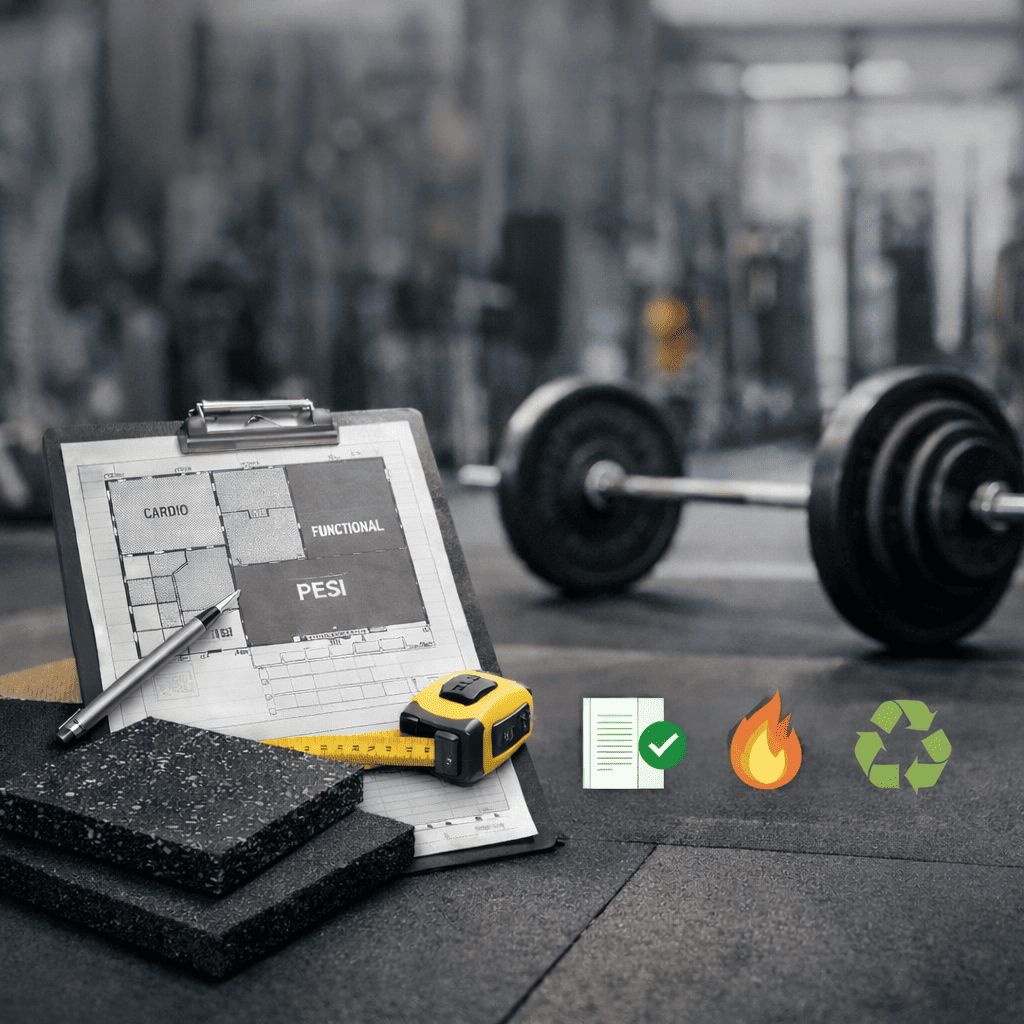
The first correct step is to divide the gym into functional zones. Even a preliminary classification, drawn on the floor plan in a simple way, already helps to avoid many wrong choices.
In the cardio and light activity area, distributed loads and continuous use prevail. Here surface continuity, stability under machinery, and resistance to daily wear and tear matter most.
In the functional, course, and middleweight area, the flooring must accompany variable activities, frequent movement, and possible impacts with small equipment. Therefore, a proper balance between stability, comfort of use and absorption capacity is needed.
The heavyweight and barbell area is the most critical. Here we are not just talking about wear and tear, but repeated impacts, significant loads, and protection of the subfloor. An undersized choice in this area almost always pays off over time.
Then there are corridors, interior pathways, and areas adjacent to escape routes, where in some contexts fire response becomes a requirement to be specifically guarded.
The point is simple: good design does not choose “gym flooring,” but identifies the most consistent solution for each zone.
Which solution to choose: first the logic, then the product
One of the most frequently asked questions is, “What thickness do I put in the weight area?” It is an understandable question, but it comes too soon. Before thickness there are other decisions that condition the choice and, if addressed in the wrong order, easily lead to cost overruns or ineffective specifications.
In areas with regular traffic, where a continuous surface is needed, the most rational solution is often roll paving. ECO-GYM ROLL responds well to this scenario: it helps maintain surface continuity and is suitable for spaces where particularly heavy impacts are not expected.
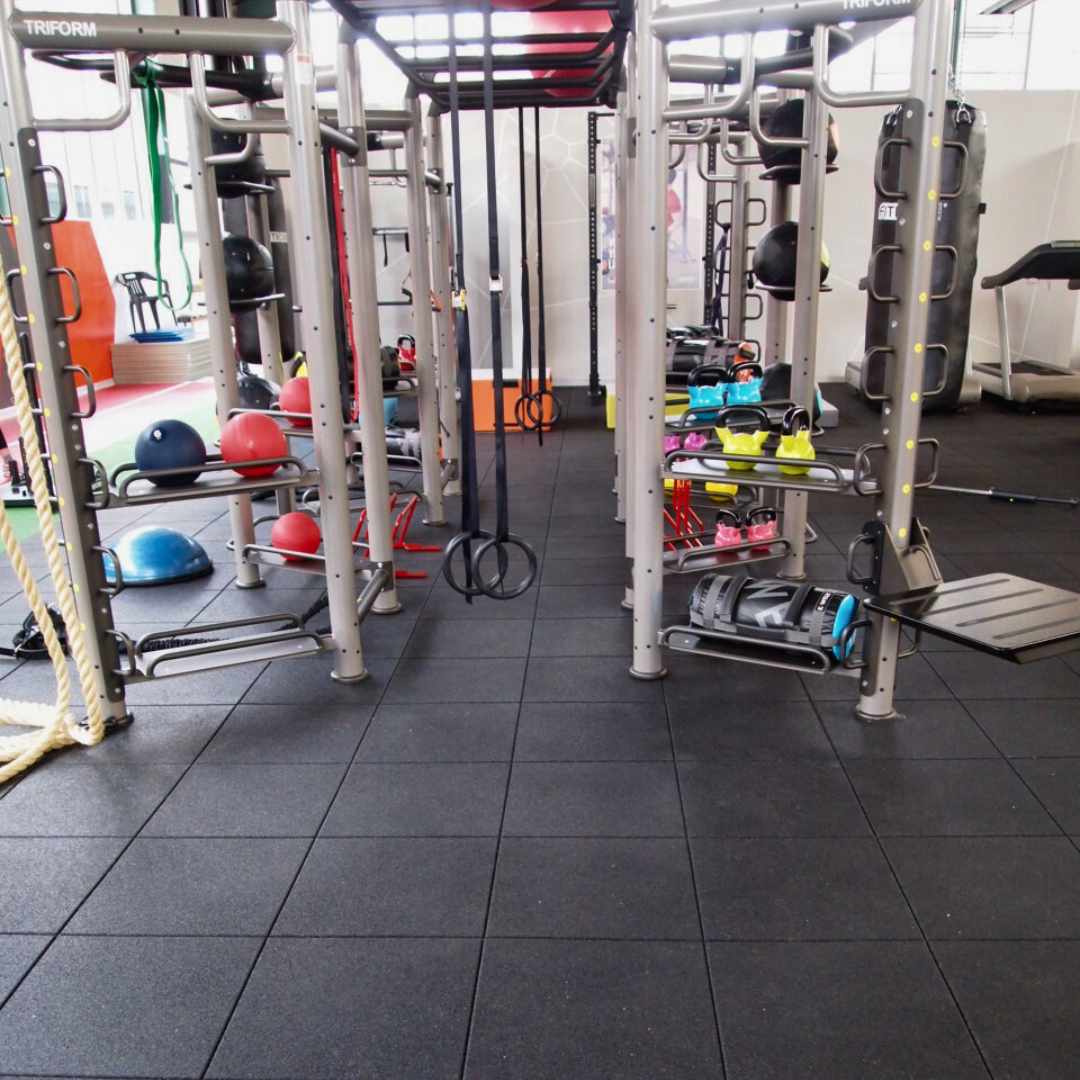
When the project includes areas with different intensities of use, or when the possibility of localized intervention over time is a real advantage, the modular plate is often the most flexible choice. ECO-GYM fits into this logic and is suitable when a versatile technical solution is needed, capable of adapting to different contexts of use.
When looking for a more uniform and smoother surface finish, ECO-GYM TOP is the natural alternative: it retains the modular logic of ECO-GYM, but with a more compact and regular surface due to the superfine grain of the surface material.
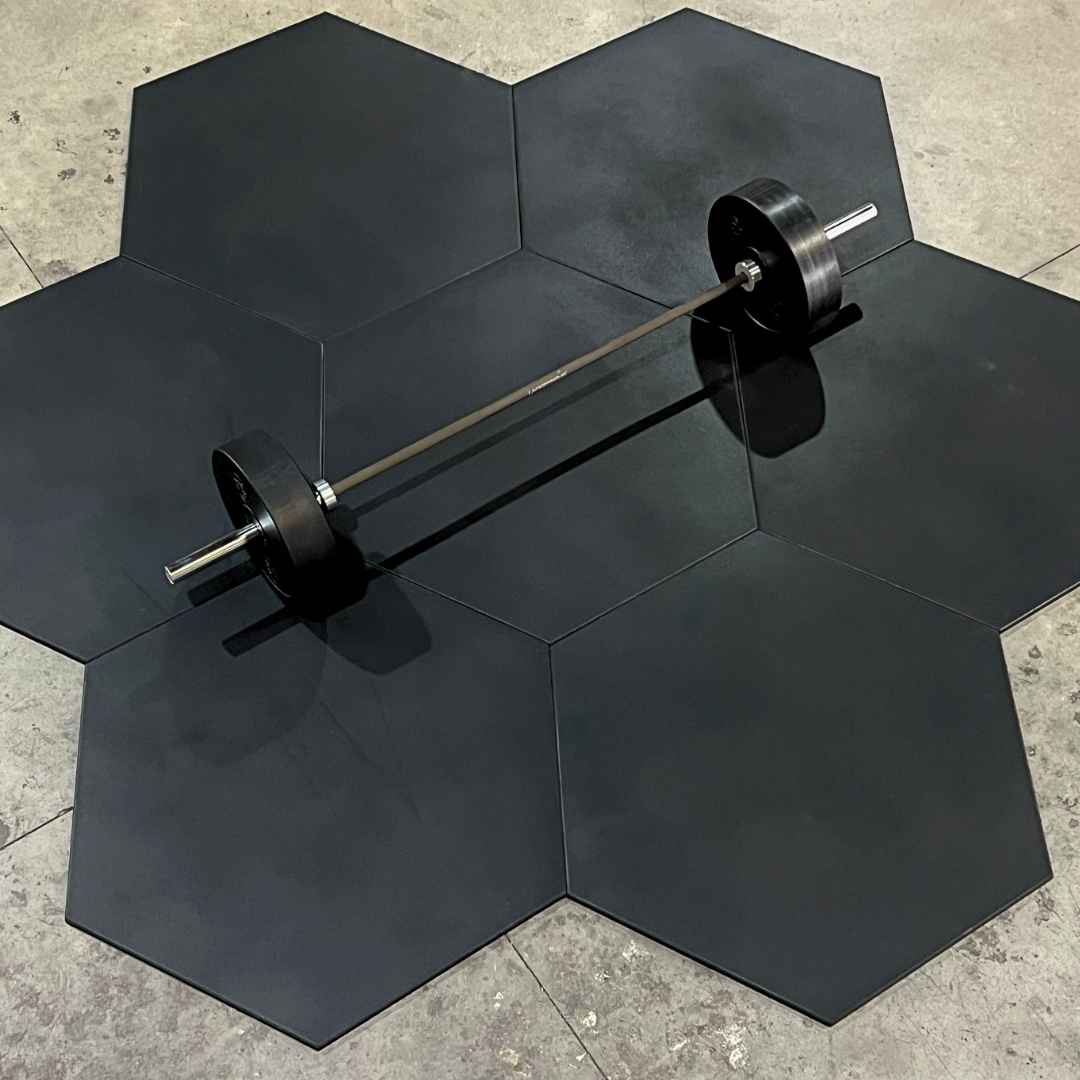
If, on the other hand, the project also attaches importance to the geometry of the module and the visual impact of the surface, ECO-GYM TOP ESA can be considered as a solution with a more pronounced formal characterization. Again, however, aesthetics only make sense if it remains consistent with the actual use of the area.
When reaction to fire comes into play, the logic changes. Here it is no longer a matter of comparing equivalent solutions, but of specifying the correct product according to a specific requirement. In standard versions, recycled rubber flooring normally has a basic classification, typically Efl; when the project requires higher performance, specific versions with improved classifications must be provided. ECO-FLAME STOP GYM should be considered precisely in this logic, i.e., when fire rating is an explicit design requirement.
One key point: it does not replace the floor of the facility
It pays to be very clear here, because it is a technical point that is often misunderstood.
In applications normally intended for fitness environments, this flooring is generally placed on an already finished surface, does not replace the floor of the structure, and is not intended, as such, to be permanently incorporated into the work. In fact, the CPR defines “construction product” as a product placed on the market for permanent incorporation into construction works, affecting the performance of the work itself. It also clarifies that the concept of construction product is related precisely to permanent incorporation in the work.
Hence, in the use configurations normally adopted for gyms and fitness rooms, a removable floor laid on finished support does not normally fall within the logic of a construction product subject to DoP and CE marking under CPR. The practical consequence is important: documentary assessment should be set up in a manner consistent with this intended use, avoiding improper requirements and focusing instead on documentation that is truly relevant to the project.
Public procurement and REMADE: when it really matters
In public procurement, material sustainability is not a decorative topic. If recycled content is to be enhanced and documented, a solid documentary basis is needed.
REMADE certification is useful precisely in this context: the scheme is designed to attest to the recycled content of products and is used as documentary support in public procurement and Green Public Procurement.
For the ECO-WELLNESS range, the point to be made very clear is that not all products should be presented in the same way. Some products, such as ECO-GYM, ECO-GYM TOP and ECO-GYM ROLL, are REMADE certified and have recycled material contents around 90 percent. Timely specifications and updated values should always be checked on individual product pages.
At the specification stage, there are three practical aspects that should not be overlooked. The first is that REMADE certification should be explicitly requested already in the document flow of the job order. The second is that when CAM documentation is needed, the product variant that is actually compatible with the one requested must be precisely verified. The third is that documented recycled content is a concrete element of the technical bid, not just a business argument.
Maintenance should be thought of before, not after
A rather frequent mistake is to consider maintenance as a matter for the manager and not the designer. In reality, a pavement can be chosen correctly and deteriorate early if no one has passed on minimum directions for use.
Therefore, it is useful to provide essential but clear instructions in the final specifications, or at least in the delivery documentation. For routine cleaning, the use of neutral detergents compatible with rubber should be indicated, avoiding excess water and aggressive products. For more intensive periodic cleaning, however, criteria compatible with the surface should be maintained.
Then there are three categories of products to avoid: solvents, strongly acidic or alkaline cleaners, and wax-based products. These are choices that can alter the surface and compromise its behavior over time.
Finally, two durability caveats are worth pointing out: avoid contact with sharp or pointed objects and clarify that a color evolution over time may be a natural characteristic of the material, not necessarily a defect.
You can learn more about it by reading the appropriate article: How to clean gym rubber flooring
How to write a specification that holds up
A specification item such as “recycled rubber flooring for gymnasium” leaves too much room for interpretation and does not really protect the project.
A more robust specification should indicate, for each zone, at least these elements: intended product family, possible variant, required format and thickness, installation method, possible fire reaction requirement, possible REMADE certification requirement, and technical documentation to be provided.
This approach makes the specifications more readable, more auditable on the construction site, and more defensible if supply compliance is challenged.
Samples and technical documentation: how to request them in a useful way
When the gym is still being defined, the most prudent choice is to verify physical samples, surface finish and technical documentation before closing the specification.
All that is needed to do this effectively is a little information: design areas, type of intended use, any fire reaction requirement, and any REMADE-related requirements.
On this basis, relevant samples, updated data sheets, and necessary documentation can be requested to complete the specification in a manner consistent with the project.
Properly designing a gymnasium with recycled rubber flooring means making a less generic and more reasoned choice. It means starting from the zoning map, assessing the actual use of the spaces, distinguishing the really relevant requirements, and setting a specification that does not leave essential points uncovered.
It also means clarifying an often overlooked aspect: in the applications normally envisioned for fitness, this flooring does not replace the floor of the structure, but is configured as a removable technical surface resting on already finished support. It is from here that the correct documentation approach also follows.
To learn more about the features, finishes and recycled material content of REMADE-certified products, the correct reference is still the individual product page.
Casei Eco-System has been producing recycled rubber flooring from end-of-life tires for more than 20 years. All products are made in Italy, REMADE® certified and available with technical documentation verified by accredited laboratories.
FAQ – Recycled rubber flooring for gymnasium
What is the best recycled rubber flooring for a gymnasium?
There is no absolute best solution, because the choice depends on the type of activity in different areas of the gym.
A cardio zone, a functional area or a weight room do not have the same requirements. Therefore, the correct choice does not start with the product, but with the function of the space and the expected loads.
Is it better to roll rubber flooring or gym tile flooring?
It depends on the context of use.
Roll paving is more suitable for areas with regular traffic and light activities, where a continuous and uniform surface is needed. Modular plates are often preferred in technical areas or areas subject to variable loads, because they allow greater design flexibility and easier management by zones.
What thickness should a gymnasium floor be?
Thickness is important, but it cannot be chosen alone.
It should be defined according to the type of activity, loads, frequency of use, presence of heavy equipment, and characteristics of the substrate. In other words, there is no right thickness that is valid for the whole gym.
Is recycled rubber flooring good for the weight room?
Yes, but only if chosen correctly.
Areas with balances, high loads, or high-impact activities require flooring designed to withstand significant stresses and protect the subfloor. An inadequate solution can reduce the life of the system and compromise the functionality of the space over time.
Is recycled rubber flooring fire retardant?
In general, no, at least not in the standard versions.
Standard recycled rubber flooring normally has a basic level fire rating, typically Efl. This means they are not automatically designed to meet more stringent fire requirements. When the project requires higher performance, specific products with improved classifications must be provided.
When do you need flooring with specific fire rating?
It is needed when the project specifically requires it, such as for particular environments or specification requirements.
In these cases, it is not enough to generically state recycled rubber flooring. The fire reaction requirement must be specified and it must be verified that the selected product is indeed suitable to meet it.
Are all recycled rubber flooring products REMADE certified?
No, not all of them.
Some products, such as ECO-GYM, ECO-GYM TOP and ECO-GYM ROLL, are REMADE certified and have recycled material contents around 90%. Point specifications and updated values can be found on the individual product pages.
Is REMADE certification useful in public procurement?
Yes, it is useful.
In public procurement, when the recycled material content needs to be enhanced and documented, REMADE certification is a concrete element to be considered already at the specification stage. This is precisely one of its stated uses in the context of Green Public Procurement.
What should be written in the specifications for a gym floor?
A voice that is too general is not enough.
In a professional specification, it is advisable to indicate at least the intended use of the area, intended product family, method of installation, any reaction-to-fire requirements, and any REMADE documentation requirement, as well as the technical documentation to be delivered.
Should gymnasium floor maintenance be considered at the design stage already?
Yes, because the durability of the system depends not only on the material chosen, but also on how it will be managed over time.
Providing minimum directions for use and cleaning, or including them in the final documentation, helps to avoid misuse and deterioration due to treatments that are not compatible with the material.
continue reading
LATEST ARTICLES